


Your website traffic is probably down. That doesn’t automatically mean your business is.
If your Website Traffic is dropping, you’re not alone, and you probably didn’t break anything. Google now answers many questions right on the search results page, and AI tools like ChatGPT answer the rest. People get what they need without clicking, so fewer visits reach your site even when nothing on it has changed.
This is for small business owners who opened their analytics, saw the line heading down, and felt their stomach drop with it. That reaction makes sense. For years, more traffic meant more business, and less traffic meant something was wrong. That rule doesn’t hold the way it used to.
We’ll cover why traffic is falling, whether AI is really to blame, what you should measure instead, and what to do about it.
Quick Take
- Nearly 60% of Google searches now end without a click to any website.
- When Google shows an AI summary, people click a regular search result about half as often.
- A traffic drop is not the same as a sales drop. The visitors who still click are often closer to buying.
- Calls, form fills, direction requests, and booked jobs tell you more than raw visit counts.
- You can’t control how Google displays results, but you can control how clear your website, Google Business Profile, and reviews are.
At Forward Digital Marketing, we work with small businesses across Southeast Georgia and beyond who want their marketing to bring in customers — not just create activity. When a client’s traffic dips, the first question we ask isn’t “how many visitors did we lose?” It’s “is the phone still ringing?”
Why Is My Website Traffic Dropping?
Most website traffic drops today come from changes in how people search, not problems with your site. Google shows answers, maps, and AI summaries at the top of the page, and AI tools answer questions directly. Searchers get what they need without clicking, so fewer visits reach your website.
Industry research backs this up. A large study of U.S. search behavior found that about 58.5% of Google searches end without a click to any website. Someone searches “what time does the hardware store close,” sees the hours in your Google Business Profile, and drives over. That’s a win for you, but it never shows up as a Website Traffic.
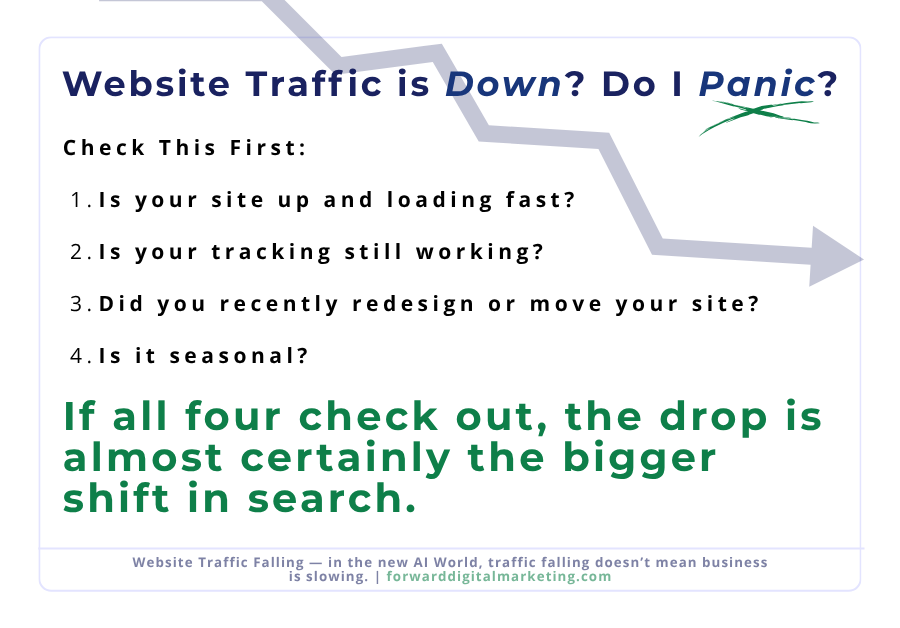
Before you blame the search engines, rule out the problems you can actually fix. Check these first:
- Is your site up and loading fast? A slow or broken site on mobile loses visitors before the page even appears.
- Is your tracking still working? A plugin update, theme change, or new cookie banner can quietly break Google Analytics. Sometimes traffic didn’t drop at all. The counting did.
- Did you recently redesign or move your site? Pages that changed addresses without redirects lose the search rankings they’d built up.
- Is it seasonal? Compare this month to the same month last year, not to last month.
If all four check out, the drop is almost certainly the bigger shift in search. That’s the part we’ll dig into next.
Is AI Really Killing Website Traffic?
AI is reducing website traffic, but unevenly. Searches for general information get hit hardest, because an AI summary can answer them completely. Searches for a local service or a business to hire still send clicks, because people need to compare, call, or book.
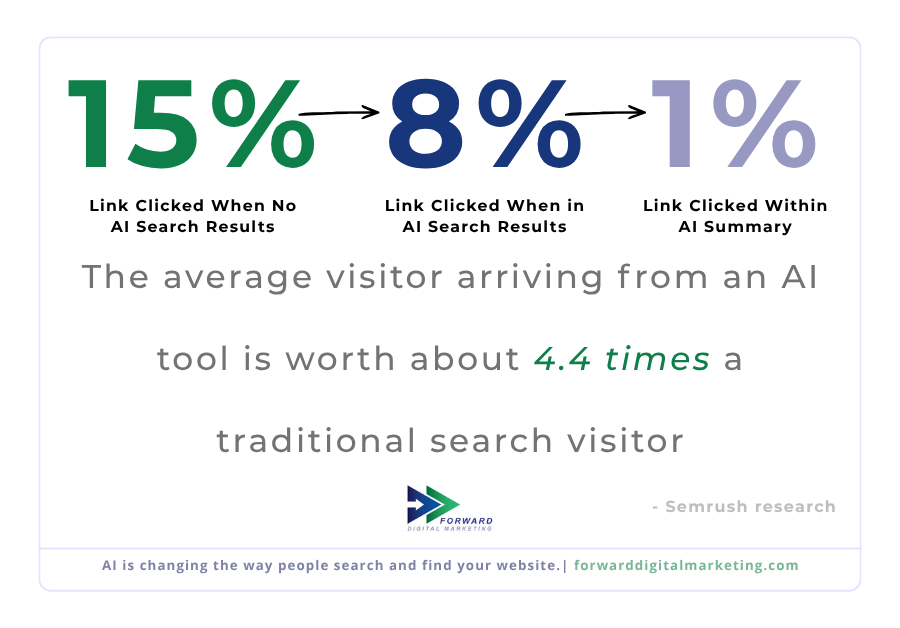
The numbers on AI summaries are hard to ignore. Pew Research Center tracked real Google searches and found people clicked a regular result 8% of the time when an AI summary appeared, compared to 15% when one didn’t. Only 1% clicked a link inside the summary itself.
Here’s the part that rarely makes the headlines: the people who do click are often more ready to act. Semrush research estimates the average visitor arriving from an AI tool is worth about 4.4 times a traditional search visitor, because they’ve already done their homework before they land on your site. Fewer people are browsing. More of the people who show up came to buy.
Being the business AI tools mention also matters. Seer Interactive found brands cited inside Google’s AI summaries earned noticeably more clicks than brands that weren’t. If you haven’t looked at how to get your business into those answers, start with our guide on how to show up in AI search without paying.
Is Website Traffic Still a Good Way to Measure Success?
Website traffic is a useful signal, but it was never the goal. The goal is customers. For most small businesses, the better measures are phone calls, form submissions, direction requests, quote requests, and booked jobs. Those numbers tell you whether your marketing is working. Visit counts only tell you how many people stopped by.
Think about it like a storefront on Main Street. A hundred people window-shopping and leaving is not better than twenty people walking in to buy. A lot of the traffic that’s disappearing was the window-shopping kind: people who wanted a quick answer and were never going to call you.
Here’s what to track instead:
- Leads per month: calls, contact forms, and quote requests combined.
- Google Business Profile actions: calls, website clicks, and direction requests, all found in your profile’s Performance tab.
- Conversion rate: the share of website visitors who take an action. If traffic falls but this rises, you’re doing fine.
- Where customers say they found you: ask every new customer. It’s free and it’s the most honest data you’ll get.
The opposite problem matters too. Additionally, if you have plenty of Website Traffic but almost no leads, the issue isn’t visibility. Moreover, it’s what happens after people arrive. Thus, that usually comes down to a homepage that doesn’t make it clear what you do. It also obscures how to reach you. Finally, we break that down in Your Homepage Has One Job.
What This Means for Your Business
For a local small business, less website traffic is manageable as long as the right people can still find you, trust you, and reach you. Your job is no longer to chase every possible click. It’s to make sure that when someone is ready to hire, your business is the obvious answer, whether they find you on Google, in an AI tool, or through a friend.
For local businesses, more of that first impression now happens before anyone reaches your website. Your Google Business Profile, your reviews, and the way other sites describe you are what search engines and AI tools pull from. Parker Insurance and Realty is a real FDM client who sees fluctuations in their website visits, but they are steady with new business. Because we also manage their social media channels, we often see the influx of homes being sold without any of that up-tick in business translating to their website visits. We have seen that, because of the way we built their website, Parker Insurance and Realty shows up in AI searches.
Your website still matters. It’s where people go to confirm you’re legitimate, check your services, and take the next step. It just needs to do that job clearly for fewer, more serious visitors. If your site is a few years old or was built in a hurry, it may be time to look at whether your website is holding your business back.
Frequently Asked Questions
Is website traffic down for everyone right now?
For most websites that depend on Google search, yes. Zero-click searches and AI summaries have reduced clicks across nearly every industry. Sites that answer general questions have been hit hardest, while local service businesses tend to hold up better.
How do I know if AI is the reason my traffic dropped?
Check Google Search Console. If your impressions are steady or rising while your clicks are falling, people are still seeing your business in search but getting their answer without clicking. That pattern points to AI summaries and zero-click results, not a problem with your site.
What’s a good amount of website traffic for a small business?
There’s no universal number. A local service business can do very well with a modest number of monthly visitors if those visitors turn into calls. Compare your traffic to your own history and watch your leads. That tells you far more than any industry average.
Why does my website get traffic but no leads?
Usually because visitors can’t quickly tell what you do, where you do it, or how to contact you. Unclear headlines, buried phone numbers, slow mobile pages, and long contact forms all cost you leads. Fixing what’s at the top of your homepage often makes the biggest difference.
How do I check my website traffic for free?
Use Google Analytics to see visits and what people do on your site, and Google Search Console to see how often you appear in search and how often people click. Your Google Business Profile’s Performance tab shows calls, direction requests, and website clicks. All three are free.
Should I pay for website traffic?
No, not the kind sold as “website traffic” packages. Those visits usually come from bots or people with no interest in your business, and they can skew your analytics. If you want to pay for visitors, use targeted advertising like Google Ads, where you reach people actively searching for what you offer.
What to Do Next
A falling traffic line is worth paying attention to, but it isn’t a verdict on your business. Search changed. The businesses that come out ahead are the ones that stop counting visits and start counting customers.
Check the right numbers
Pull up your leads, calls, and Google Business Profile actions for the last six months. Compare them to your traffic. You may find the business side never dropped at all.
Strengthen your profile
More customers meet you on Google before they ever reach your website. Make sure your Google Business Profile is complete, current, and full of recent reviews.
Get a second set of eyes
Not sure whether your drop is the search shift or a real problem? We’ll look at your numbers with you and tell you straight.